Selected Work
Built to stay shipped.
Client projects, case studies, and the track record behind them. Made to hold up after launch, not just through it.
01 // Freelance Work
Client projects delivered end to end, from brief to production.
- Freelance2026
CleanTank Services
I built a multi-page Next.js site for an industrial water-tank cleaning company serving hospitals, government bodies, and franchise partners across India. Service quotes and franchise applications run through separate lead funnels, and the content is pulled from Contentful so the team can update copy and photos without a deploy.
Visit Live →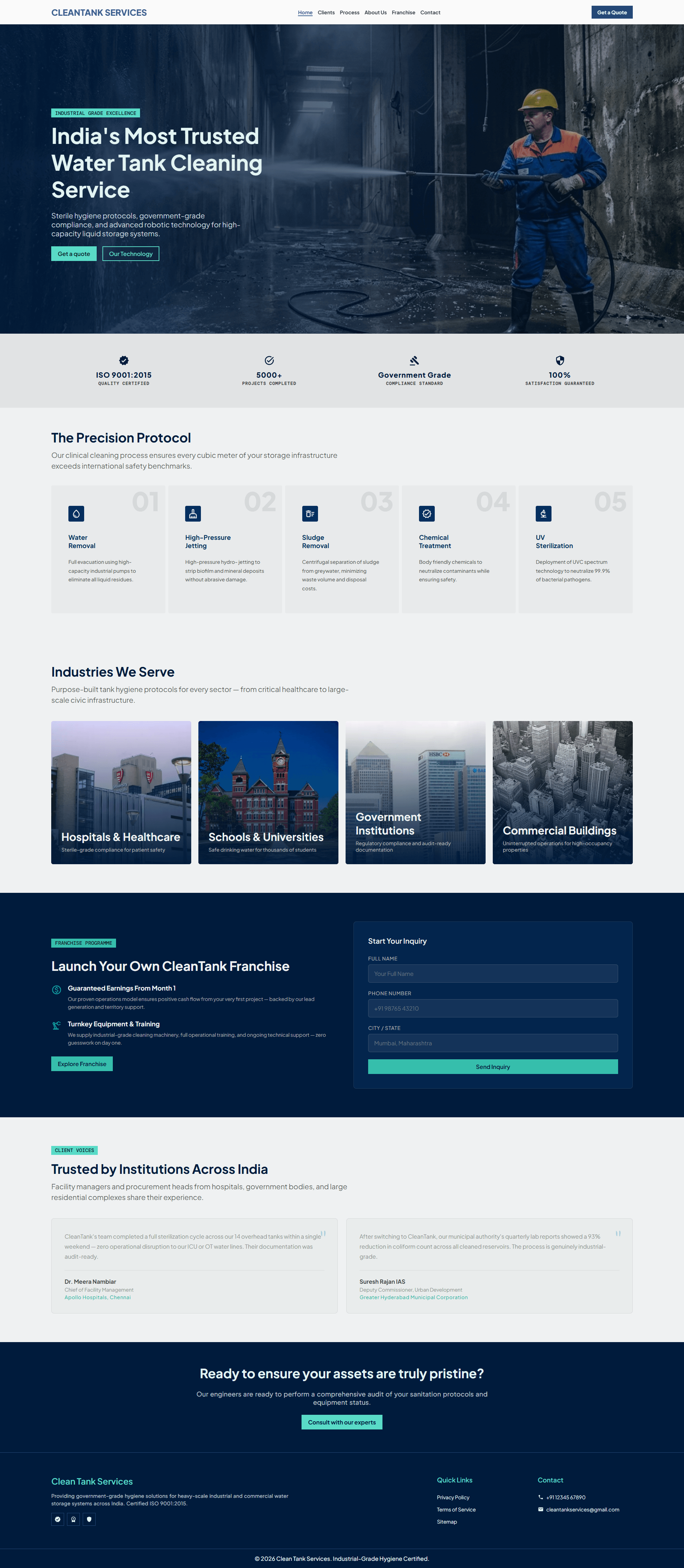

- Freelance2026
Bakery Storefront Template
A themeable digital storefront and WhatsApp-order funnel for boutique bakeries, built once to re-skin and sell to new clients instead of rebuilding the same ordering flow each time.
Visit Live →

02 // Case Studies
Deeper looks at how I approach architecture, constraints, and shipping real systems.
- BuildDec 2025 — Jun 2026
Creation Hub
putting an AI assistant inside the product, not next to it
I architected and shipped Creation Hub, the workspace where our customers plan marketing experiments by talking to an AI assistant. Instead of a chat window that only gives advice, I built one where the AI's answers arrive as working parts of the app — so a user can ask a question, see the numbers, think out loud, and act on the answer without ever leaving the conversation.
TypeScriptReact 19Next.js 15WebSockets (Socket.IO)TanStack QueryEmotionPrismaPostgreSQLClickHouseTurborepoRead full case study →
03 // Projects
Independent projects, built and shipped end to end.
- Build2026
ez-gform
Build your own form UI and send responses straight to a Google Form, with no backend. A typed core, a React hook, and a CLI that finds the field ids and generates the form code for you.
TypeScriptReactNode.jsTurborepoNext.jsVitest/ The Constraints
Google Forms is a free, reliable place to collect responses, but its UI can't be styled to match a site. Wiring a custom form to it means digging through page source for hidden entry ids and hand-encoding every question type. The usual alternative is running a backend just to receive a contact form.
/ The Approach
I split the work into small packages in a Turborepo monorepo. A zero-dependency core parses a public form's page into a typed schema, validates answers, and encodes every question type, including grids, dates, and "Other" options. On top of it sit a React hook (useGoogleForm), code generators for types, React components, and plain HTML, and a CLI that runs through npx. I checked the parser against live forms, tested it with project-owned fixtures, and set up releases to publish to npm on every push to main through trusted publishing.
/ The Outcome
Five packages are live on npm under @ez-gform, alongside a docs site with an interactive playground. A custom form now takes one npx command to get the entry ids and a few lines of React, and responses land in the Google Form and its Sheet like any other. The CLI can also send a test submission and read Google's reply, so a form can be confirmed working before it ships.
- 5 packages published on npm
- Zero-dependency core
- Form URL to React component in one command
- Build2024
Kami UI
A minimalist, accessible component library designed for rapid high-fidelity prototyping. Focused on strict architectural precision and developer ergonomics.
ReactTypeScriptNext.jsEmotionStorybook/ The Constraints
Most component libraries prioritize flexibility over consistency, leading to fragmented design systems and slow prototyping cycles.
/ The Approach
Built a themeable, accessible component library with strict architectural precision. Implemented reusable components, theming support, and accessibility best practices from the ground up.
/ The Outcome
A production-ready component library that enables rapid high-fidelity prototyping with consistent, accessible user interfaces.
- Themeable design system
- Accessibility best practices baked in
- Rapid prototyping workflow
04 // Experience
Where I've worked, and what I shipped there.
- Worked as a full-stack engineer on an AI-driven conversion rate optimization platform, building and scaling personalized web experiences using React, Node.js, and modern frontend caching and data-fetching strategies.
- Re-architected the monorepo by separating applications, shared UI components, and data layers, enabling independent deployments and improving build performance by approximately 15-20%.
- Designed and implemented backend APIs and core database workflows using NestJS, Express, and Prisma, supporting high-impact product features and internal service integrations.
- Improved frontend performance, reliability, and routing stability through optimized rendering patterns, client-side caching, and migrating from Next.js App Router to Pages Router for improved ecosystem compatibility.
- Led frontend development for large-scale internal healthcare and insurance portals, enabling hospital-side workflows such as agent-assisted discharge and claims processing.
- Owned and delivered a production-grade portal end-to-end, including frontend architecture, state management, and close collaboration with backend, DevOps, QA, and product stakeholders.
- Unified multiple frontend codebases into a single Nx-powered monorepo, reducing code duplication by approximately 20% and improving developer productivity through optimized tooling, HMR, and linting workflows.
- Migrated a monolithic frontend application to a micro-frontend architecture, improving scalability and release velocity while reducing JavaScript bundle size by roughly 45% using code splitting, lazy loading, and tree shaking.
- Designed and developed a responsive marketing website to establish the company's online presence and showcase its car rental services.
- Built a static, high-performance website using Next.js and Lottie animations, focusing on fast load times and clean visual presentation.
- Developed modern, performant, and maintainable frontend code for multiple client-facing and internal web applications.
- Collaborated closely with designers and management to implement UI requirements, document features, and support end-to-end project delivery.
Have something like this in mind?
I'm currently available for freelance and full-time opportunities. Reach out and let's talk about what you're building.